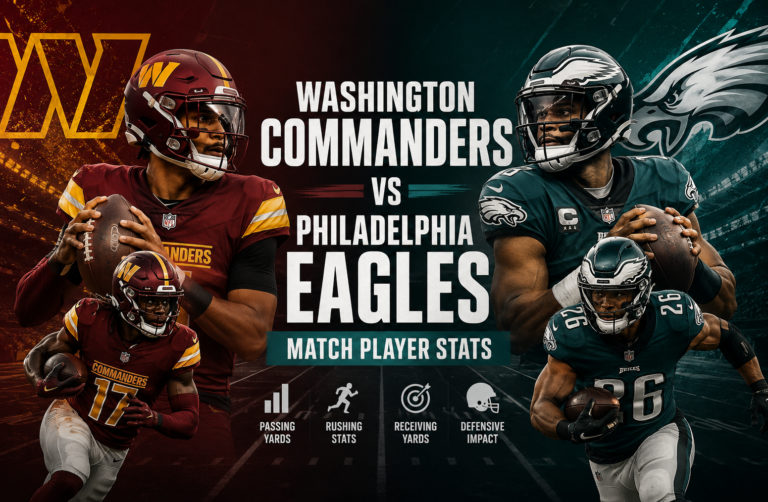
Washington Commanders vs New York Giants Match Player Stats
The rivalry behind the Washington Commanders vs New York Giants Match Player Stats continues to attract NFL fans because these NFC East battles are rarely predictable. Every meeting between these teams brings physical defense, momentum swings, quarterback pressure, and standout individual performances that shape the season standings. Whether the matchup takes place in Washington or New York, player statistics often reveal deeper insights than the final score alone.
Fans searching for detailed performance breakdowns usually want more than basic box scores. They want to understand which players controlled the game, how offensive schemes performed under pressure, why defenses succeeded or failed, and which moments changed the outcome. This article provides a complete analysis of the matchup, including quarterback efficiency, rushing production, receiving impact, defensive dominance, special teams performance, coaching decisions, and advanced football insights.
NFL divisional games are often decided by small details. Third down conversions, red zone efficiency, quarterback protection, defensive takeaways, and explosive plays frequently determine the winner. By examining those details carefully, the statistical story becomes much clearer.
Why This Rivalry Always Produces Meaningful Stats
The Commanders and Giants share one of the oldest rivalries in professional football. Because they play twice every season, coaches and players understand each other’s systems deeply. That familiarity creates tightly contested games where player execution becomes more important than surprise tactics.
Several factors make these matchups statistically interesting:
- Defensive pressure usually increases
- Quarterback decision making becomes critical
- Turnovers often decide momentum
- Running backs face stacked defensive fronts
- Receivers must win contested catches
- Coaching adjustments matter heavily in second halves
This is why analyzing the Washington Commanders vs New York Giants Match Player Stats provides more insight than simply reviewing the final score.
Quarterback Performance Breakdown
Quarterbacks remain the center of every modern NFL game. In divisional matchups, their ability to remain calm under defensive pressure becomes especially important.
Washington Quarterback Analysis
Washington’s offensive success often depends on quick reads, intermediate passing accuracy, and pocket mobility. Against the Giants defense, quarterbacks typically face aggressive blitz packages designed to force mistakes.
Key quarterback metrics that usually define success include:
| Category | Importance |
| Completion Percentage | Sustains offensive rhythm |
| Yards Per Attempt | Measures downfield effectiveness |
| Touchdown to Interception Ratio | Indicates decision quality |
| Sack Avoidance | Reflects pocket awareness |
| Third Down Passing | Keeps drives alive |
When Washington quarterbacks succeed against New York, it usually happens because they release the ball quickly and avoid forcing passes into tight coverage.
Short crossing routes and play action concepts often create the best opportunities against the Giants secondary. Mobile quarterbacks also tend to perform better because they can escape collapsing pockets.
New York Quarterback Analysis
Giants quarterbacks traditionally rely on timing based throws and controlled offensive drives. Washington’s defensive front frequently creates interior pressure, forcing quarterbacks to speed up their progressions.
Strong performances generally include:
- Efficient short passing
- Limited turnovers
- Smart use of checkdowns
- Effective play action execution
- Red zone composure
Quarterbacks who struggle against Washington usually hold the ball too long or attempt risky throws under pressure.
One of the biggest indicators in these matchups is quarterback efficiency on third down. Sustained drives wear down defensive fronts and shift time of possession dramatically.
Running Back Statistics and Ground Game Impact
Rushing performance often changes the entire identity of NFC East games. Physical football becomes more important late in the season when weather conditions worsen and playoff pressure increases.
Washington Rushing Attack
Washington’s rushing strategy commonly focuses on:
- Interior power runs
- Zone blocking concepts
- Screen passes to running backs
- Red zone rushing efficiency
A productive running game helps Washington control tempo and reduce defensive exposure.
Important running back stats include:
| Statistic | Why It Matters |
| Yards After Contact | Shows physical dominance |
| Explosive Runs | Creates momentum swings |
| Red Zone Carries | Indicates trust from coaches |
| Receiving Yards | Expands offensive flexibility |
| First Down Runs | Extends drives |
When Washington rushers consistently gain four to five yards early in drives, the offense becomes significantly harder to defend.
Giants Ground Game
The Giants often depend heavily on their rushing attack to balance offensive pressure. Successful rushing performances force linebackers closer to the line of scrimmage, creating passing lanes later in the game.
Key observations usually include:
- Outside zone efficiency
- Success against stacked defensive fronts
- Running back vision and patience
- Ball security under contact
Strong rushing production frequently correlates with Giants victories in divisional games.
Wide Receiver and Tight End Contributions
Receiving production in divisional matchups often depends on route precision rather than pure athleticism. Defensive coordinators understand opposing star receivers extremely well, so winning individual matchups becomes difficult.
Washington Receiving Leaders
Washington receivers typically succeed through:
- Intermediate crossing routes
- Yards after catch opportunities
- Slot receiver mismatches
- Tight end seam routes
Important receiving statistics include:
| Receiving Metric | Value |
| Catch Rate | Measures reliability |
| Yards After Catch | Indicates open field ability |
| Target Share | Shows offensive trust |
| Red Zone Targets | Reflects scoring importance |
| Explosive Receptions | Changes field position |
Possession receivers often become critical in close games because they help sustain drives during high pressure moments.
Giants Receiving Production
The Giants offense usually emphasizes timing routes and quick separation concepts. Receivers who excel at creating space underneath coverage tend to produce the strongest performances.
Factors influencing receiving success include:
- Offensive line protection
- Quarterback timing
- Defensive coverage disguises
- Third down route execution
Tight ends frequently become important safety valves when defensive pressure increases.
Defensive Player Statistics That Changed the Game
Defense remains one of the defining characteristics of NFC East football. Even in an era dominated by offense, divisional games are frequently controlled by defensive execution.
Washington Defensive Standouts
Washington defenses traditionally rely on aggressive pass rushes and physical front seven play.
Critical defensive statistics include:
| Defensive Category | Game Impact |
| Sacks | Kills offensive momentum |
| Quarterback Hits | Creates pressure fatigue |
| Tackles for Loss | Disrupts rushing rhythm |
| Forced Fumbles | Generates turnovers |
| Pass Breakups | Prevents explosive plays |
Elite defensive line performances can completely alter offensive game plans.
Linebackers also play a major role in limiting screen passes and containing mobile quarterbacks.
Giants Defensive Production
The Giants defense often emphasizes blitz pressure and disguised coverages.
Defensive success usually depends on:
- Edge pressure consistency
- Secondary communication
- Third down stops
- Red zone discipline
Turnovers become especially important in close rivalry games because both teams understand each other’s offensive tendencies.
Interceptions frequently occur when quarterbacks attempt aggressive throws late in games.
Offensive Line Performance Analysis
Offensive line statistics rarely receive enough attention despite their massive influence on game outcomes.
The best offensive lines in these matchups usually excel in:
- Pass protection communication
- Blitz recognition
- Run blocking leverage
- Pocket stability
- Goal line execution
Pressure rate allowed is often more important than total sacks because constant pressure affects quarterback decision making throughout the game.
Washington and New York both prioritize defensive front strength, making offensive line performance one of the most important hidden factors in these games.
Third Down Efficiency and Possession Control
One of the most overlooked aspects of the Washington Commanders vs New York Giants Match Player Stats is third down performance.
Third down efficiency determines:
- Time of possession
- Defensive fatigue
- Field position
- Offensive rhythm
Teams converting third downs consistently usually dominate the pace of play.
Key Third Down Factors
Successful third down offenses generally feature:
- Quick passing concepts
- Reliable slot receivers
- Effective pass protection
- Smart quarterback reads
Defensively, stopping third downs requires:
- Pressure without missed assignments
- Tight coverage communication
- Strong tackling fundamentals
A single failed third down conversion can completely change momentum in divisional games.
Red Zone Performance Breakdown
Red zone execution separates good teams from great teams.
Inside the opponent’s 20 yard line, space becomes limited and defensive pressure increases dramatically.
Offensive Red Zone Priorities
Successful offenses usually rely on:
- Tight end mismatches
- Mobile quarterback options
- Power rushing concepts
- Play action deception
Defensive Red Zone Goals
Defenses aim to:
- Force field goals
- Compress passing lanes
- Increase physical pressure
- Eliminate explosive plays
Teams with stronger red zone efficiency typically win close NFC East matchups.
Turnovers and Momentum Shifts
Turnovers are often the defining factor in rivalry games.
A single interception or fumble can:
- Shift crowd energy
- Improve field position
- Increase defensive confidence
- Change coaching strategy
Most Influential Turnover Metrics
| Turnover Statistic | Importance |
| Interceptions | Stops drives immediately |
| Forced Fumbles | Creates momentum swings |
| Turnover Differential | Strong predictor of winning |
| Points Off Turnovers | Converts mistakes into scoring |
Quarterbacks with disciplined decision making usually perform better in these emotional divisional environments.
Coaching Strategy and Adjustments
Coaching adjustments become especially noticeable during second halves.
Experienced coaching staffs often:
- Alter pass protection schemes
- Increase blitz frequency
- Change coverage disguises
- Target weaker defenders
- Adjust run fits
Successful halftime adjustments frequently decide close contests.
Washington and New York coaching staffs typically emphasize field position and minimizing mistakes during divisional games.
Advanced Statistical Insights
Traditional box scores only tell part of the story. Advanced metrics reveal deeper performance patterns.
Important Advanced Metrics
| Metric | Meaning |
| EPA Per Play | Offensive efficiency value |
| Pressure Rate | Pass rush effectiveness |
| Yards Before Contact | Offensive line success |
| Explosive Play Rate | Big play frequency |
| Success Rate | Consistent positive gains |
These metrics help explain why some players impact games more than raw yardage totals suggest.
Advanced analytics also reveal whether a team’s performance was sustainable or driven by isolated big plays.
Special Teams Impact
Special teams often become underrated game changers in divisional football.
Key special teams factors include:
- Punt field position
- Kick return explosiveness
- Field goal consistency
- Coverage discipline
A missed field goal or long return can completely change momentum.
Weather conditions also influence special teams performance heavily during late season games.
Most Memorable Individual Performances
Throughout this rivalry, several players have delivered standout performances through:
- Multi touchdown games
- Dominant rushing totals
- Game changing interceptions
- Clutch fourth quarter drives
- Defensive takeaways
These performances often become defining moments in season narratives.
Fans usually remember dramatic finishes, but consistent statistical dominance throughout the game often matters more.
How Injuries Influence Match Player Stats
Injuries dramatically affect game planning and statistical production.
Missing players can impact:
- Offensive rhythm
- Defensive communication
- Pass protection quality
- Depth rotations
- Red zone execution
Backup players sometimes produce surprising breakout performances in rivalry games because defensive coordinators focus heavily on star players.
Depth becomes increasingly important late in the NFL season.
Fan Expectations Versus Statistical Reality
Fans often focus heavily on quarterbacks, but statistical analysis frequently shows games are won elsewhere.
Some overlooked realities include:
- Offensive lines influence quarterback stats heavily
- Defensive pressure creates turnovers indirectly
- Time of possession impacts defensive stamina
- Field position affects scoring efficiency
Understanding these deeper factors provides a more accurate picture of why teams win or lose.
Comparing Offensive Philosophies
Washington and New York often approach offense differently depending on roster construction and coaching identity.
Washington Offensive Style
Typically emphasizes:
- Balanced play calling
- Intermediate passing
- Controlled tempo
- Defensive support
Giants Offensive Style
Often prioritizes:
- Ball control
- Rushing consistency
- Play action opportunities
- Limiting turnovers
These contrasting approaches create fascinating statistical matchups.
Defensive Matchups That Matter Most
Certain positional battles consistently influence outcomes.
Important Matchups
| Matchup | Why It Matters |
| Edge Rushers vs Tackles | Determines pocket stability |
| Slot Receivers vs Nickel Corners | Impacts third downs |
| Tight Ends vs Linebackers | Creates red zone mismatches |
| Running Backs vs Interior Line | Controls offensive balance |
Winning even one major matchup can tilt the game significantly.
Statistical Trends Across Recent Meetings
Recent meetings have shown several patterns:
- Defensive pressure remains high
- Explosive offensive plays are limited
- Turnovers strongly predict winners
- Fourth quarter execution is critical
Close games also increase the importance of coaching discipline and clock management.
What Fans Should Watch in Future Matchups
Future games between these franchises will likely continue emphasizing:
- Quarterback development
- Defensive front dominance
- Offensive line improvement
- Red zone execution
As NFL offenses evolve, teams capable of balancing explosive plays with disciplined football usually gain an advantage.
The rivalry remains compelling because both organizations frequently rebuild while maintaining strong defensive identities.
The Bigger Meaning Behind the Stats
Statistics are not just numbers. They explain how games unfold emotionally and strategically.
A quarterback completing short third down passes repeatedly may not produce viral highlights, but those plays often determine victory.
Similarly, a defensive tackle occupying blockers may never appear prominently in box scores while still changing the entire game.
Understanding football statistics properly requires context, not just totals.
That is why deep analysis of the Washington Commanders vs New York Giants Match Player Stats provides meaningful insight for fans, analysts, fantasy football players, and bettors alike.
Frequently Asked Questions
Why are Commanders vs Giants games usually close?
These teams know each other’s systems extremely well because they play twice every season in the NFC East division. Familiarity reduces surprise advantages.
Which statistics matter most in these matchups?
Turnovers, third down efficiency, quarterback pressure, and red zone scoring are usually the most important indicators.
Why is defensive pressure so important in divisional games?
Quarterbacks face more disguised blitzes and tighter coverage because defensive coordinators study opponents extensively during repeated matchups.
How do offensive lines influence player stats?
Strong offensive line play improves rushing efficiency, quarterback protection, passing accuracy, and overall offensive rhythm.
Are advanced analytics useful for football analysis?
Yes. Metrics like pressure rate, EPA per play, and success rate help explain efficiency better than basic yardage totals.
Why do turnovers change momentum so dramatically?
Turnovers affect field position, crowd energy, coaching decisions, and player confidence simultaneously.
Conclusion
The Washington Commanders vs New York Giants Match Player Stats reveal far more than individual numbers on a scoreboard. They show how quarterback decisions, defensive pressure, rushing consistency, coaching adjustments, and situational execution combine to shape outcomes in one of the NFL’s most competitive divisional rivalries.
Every statistical category contributes to the larger story. A critical third down conversion, a red zone stop, a forced fumble, or a perfectly timed blitz can change the direction of the entire game. Fans who analyze these deeper details gain a much better understanding of why teams succeed or fail.
As both franchises continue evolving, future matchups will remain important for playoff positioning, divisional pride, and player development. That ensures these games will continue producing compelling performances and valuable statistical insights for years to come.