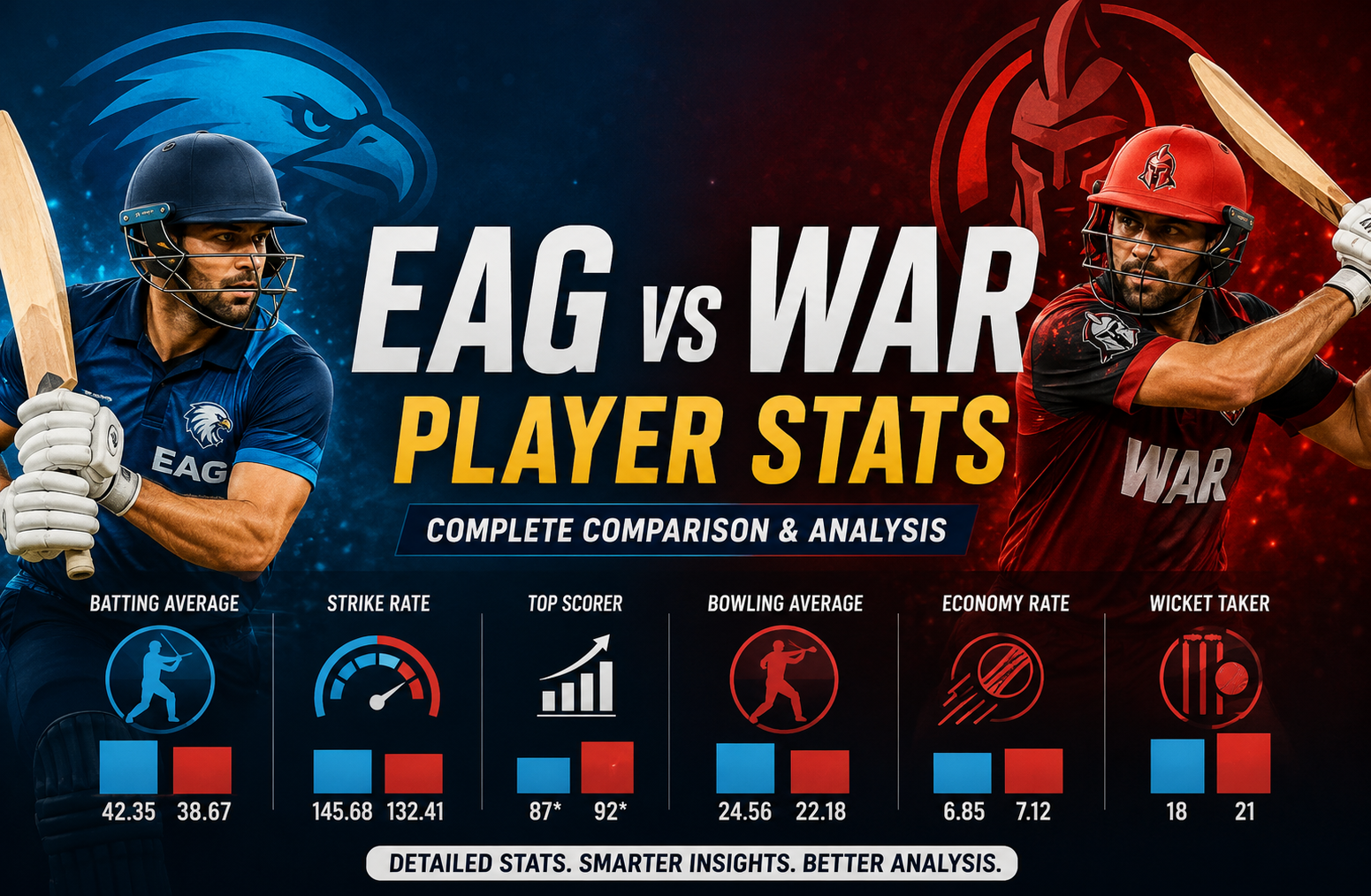
EAG vs WAR Player Stats
EAG vs WAR Player Stats is one of the most searched topics among cricket fans who want more than a basic scorecard. People are no longer satisfied with seeing only runs and wickets. They want context, player impact, consistency trends, pressure performance, strike rate efficiency, bowling economy, fielding contributions, and match turning moments. That is exactly why detailed statistical breakdowns now matter more than ever.
When I started analyzing domestic and franchise level cricket data closely, one pattern became obvious. Raw numbers alone never tell the full story. A batter scoring 40 runs at a strike rate of 210 during a difficult chase may have played a far more important innings than someone scoring a slow 75 in easier conditions. In the same way, a bowler with only one wicket can still dominate a game through disciplined line and length, dot ball pressure, and tactical overs.
This article delivers a deep and people first analysis of EAG vs WAR Player Stats by focusing on performance quality, match influence, consistency patterns, tactical insights, and real cricketing value. Instead of recycling surface level numbers, this guide explains what the stats actually mean for fans, fantasy cricket players, analysts, and regular followers of the game.
Understanding EAG vs WAR Player Stats
The phrase EAG vs WAR Player Stats usually refers to the complete player performance breakdown from matches between the EAG and WAR teams. These statistics may include:
- Total runs scored
- Batting strike rates
- Bowling economy rates
- Wickets taken
- Boundary percentage
- Dot ball percentage
- Catch efficiency
- Partnership impact
- Powerplay performance
- Death over effectiveness
- Match winning contributions
Modern cricket analysis has evolved significantly over the past decade. Fans now study advanced metrics because they provide a clearer picture of how players influence outcomes under different match conditions.
For example, a batter who consistently performs during high pressure run chases often becomes more valuable than someone who scores heavily only in low pressure situations. Similarly, bowlers who maintain tight economy rates in the death overs are often considered elite performers even if their wicket count looks average.
Why Detailed Player Stats Matter in Modern Cricket
Cricket is no longer judged only through traditional scorecards. Coaches, analysts, broadcasters, fantasy league players, and even casual fans now rely heavily on data driven evaluation.
Better Match Understanding
Detailed statistics help viewers understand why a team won or lost. A team may lose despite having more boundaries because they struggled against spin during middle overs.
Fantasy Cricket Decision Making
Fantasy cricket users study player form, strike rotation, bowling matchups, and venue trends before selecting teams. EAG vs WAR Player Stats can help fantasy users identify undervalued performers.
Identifying Consistency
One good performance does not define a player. Long term statistical analysis helps identify consistency.
Key indicators include:
- Average runs across recent matches
- Performance against pace and spin
- Wicket taking frequency
- Economy rate stability
- Pressure situation performance
Tactical Team Planning
Teams use player statistics to create strategies.
Examples include:
- Targeting weaker bowlers in death overs
- Using spin against left handed batters
- Adjusting field placements based on scoring zones
- Planning powerplay aggression levels
According to the official laws and strategic guidance shared by the International Cricket Council, data analysis has become an increasingly important part of modern cricket preparation.
Key Metrics That Define Match Impact
Many readers search for EAG vs WAR Player Stats expecting only batting and bowling tables. However, meaningful analysis requires understanding the deeper metrics behind those numbers.
Batting Strike Rate
Strike rate measures scoring speed.
A strike rate above 140 in T20 cricket is usually considered highly aggressive and valuable. However, strike rate must always be judged according to match situation.
For example:
- 35 runs from 15 balls during a chase can change momentum instantly
- 50 runs from 45 balls may slow the innings significantly
Boundary Percentage
Boundary percentage reveals how often a player scores fours and sixes.
Higher boundary frequency usually indicates:
- Strong power hitting ability
- Better pressure handling
- Improved scoring acceleration
Dot Ball Percentage
This is one of the most underrated statistics.
Batters with high dot ball percentages often create scoreboard pressure for themselves and teammates.
Bowlers with high dot ball percentages usually control matches effectively even without taking wickets.
Bowling Economy Rate
Economy rate becomes critical in shorter formats.
A bowler conceding only six runs per over in T20 cricket can completely shift match momentum.
Bowling Strike Rate
Bowling strike rate measures how frequently a bowler takes wickets.
Lower bowling strike rates indicate more regular breakthroughs.
Pressure Over Performance
Pressure overs usually include:
- Final overs of a chase
- Death overs while defending
- Powerplay overs against aggressive batting
Players who consistently perform during these phases often become match winners.
Batting Analysis in EAG vs WAR Matches
Batting numbers should never be viewed in isolation. Conditions, bowling quality, match situation, pitch behavior, and required run rate all influence performance value.
Top Order Influence
The top order usually determines innings momentum.
Strong opening partnerships can:
- Reduce pressure on middle order batters
- Allow calculated aggression later
- Improve powerplay scoring
- Build platform for big totals
When studying EAG vs WAR Player Stats, top order efficiency often becomes a key deciding factor.
Important top order metrics include:
- Powerplay strike rate
- Boundary frequency
- Balls faced percentage
- Dismissal patterns
Middle Order Stability
Middle order batters are often the glue of a cricket team.
Their role may include:
- Rebuilding after collapses
- Rotating strike against spin
- Accelerating late innings
- Managing difficult chases
A middle order batter scoring 45 from 28 balls under pressure may provide more impact than an opener scoring 70 on an easy batting pitch.
Finisher Performance
Finishers are among the most valuable players in modern T20 cricket.
Key qualities include:
- High boundary conversion
- Calm decision making
- Ability to handle yorkers
- Strong six hitting ability
Statistics for finishers should focus heavily on:
- Death over strike rate
- Boundary percentage
- Chase success contributions
- Average runs in final five overs
Bowling Analysis and Match Control
Bowling performance analysis has become far more advanced than simple wicket counting.
Modern analysts evaluate:
- Pressure creation
- Phase control
- Variation effectiveness
- Matchup success
- Dot ball sequences
Powerplay Bowlers
Powerplay bowlers must balance aggression and control.
Their primary goals include:
- Taking early wickets
- Restricting boundaries
- Creating scoreboard pressure
A bowler taking one wicket while conceding only 15 runs in four overs may contribute more than someone taking two expensive wickets.
Spin Bowling Influence
Spin bowlers often control the middle overs.
Effective spin bowling can:
- Slow scoring momentum
- Force risky shots
- Create false stroke pressure
- Break partnerships
In many EAG vs WAR Player Stats reviews, spin efficiency becomes one of the biggest turning points.
Death Bowling Performance
Death bowling is arguably the hardest skill in modern T20 cricket.
Bowlers are expected to defend against:
- Ramp shots
- Reverse scoops
- Deep crease hitting
- Boundary targeting
Important death bowling metrics include:
- Yorkers executed successfully
- Boundary prevention percentage
- Economy under pressure
- Wickets in final overs
Fielding Statistics Often Ignored by Fans
Most casual fans focus only on batting and bowling, but fielding can decide tight matches.
Modern fielding analysis includes:
- Catch success percentage
- Direct hit run outs
- Boundary saves
- Diving stops
- Throw accuracy
A single saved boundary can completely change the result of a close game.
Why Fielding Matters More Today
Cricket has become faster and more aggressive.
Teams regularly score:
- 180 plus in T20 cricket
- 300 plus in ODI cricket
This means every run saved becomes increasingly valuable.
Elite fielders contribute through:
- Athletic movement
- Strong anticipation
- Fast reflexes
- Intelligent positioning
Match Context Changes Everything
One of the biggest mistakes people make while reviewing EAG vs WAR Player Stats is ignoring context.
Statistics must always be analyzed alongside:
- Pitch conditions
- Match pressure
- Toss influence
- Weather impact
- Opposition strength
- Ground dimensions
Flat Pitch vs Difficult Pitch
Scoring 60 runs on a flat batting surface is very different from scoring 60 on a slow turning pitch.
Similarly:
- Economy rate of seven may be excellent on a batting paradise
- Economy rate of seven may be average on a bowler friendly pitch
Pressure Chases
Pressure changes player behavior.
Batters chasing large targets often:
- Take greater risks
- Attack earlier
- Lose wickets trying to accelerate
This is why pressure adjusted analysis is important.
Advanced Statistical Trends Fans Should Watch
Cricket analytics has entered a more sophisticated era.
Professional teams now study patterns that casual viewers rarely notice.
Matchup Data
This involves analyzing how specific batters perform against certain bowlers.
Examples include:
- Left handed batter against leg spin
- Aggressive opener against short ball pace
- Finisher against yorker specialists
Phase Based Performance
Modern cricket is divided into phases.
Each phase requires different skills.
Powerplay Overs
- Aggressive stroke play
- Swing bowling management
- Boundary targeting
Middle Overs
- Strike rotation
- Spin handling
- Partnership building
Death Overs
- Big hitting
- Yorker execution
- Pressure handling
Consistency Index
Consistency matters more than occasional brilliance.
Analysts often evaluate:
- Runs across last ten innings
- Economy trends over recent matches
- Wicket taking frequency
- Performance against strong teams
Common Misinterpretations of Cricket Stats
Statistics can be misleading without proper understanding.
High Runs Do Not Always Mean Great Performance
A batter may score heavily after the match is already out of reach.
These runs often carry less tactical value.
Wicket Count Can Hide Expensive Bowling
A bowler may take wickets while conceding excessive runs.
This can sometimes hurt overall team performance.
Strike Rate Requires Context
A strike rate of 120 can be:
- Excellent on a difficult pitch
- Poor on a batting friendly surface
Economy Rate Alone Is Not Enough
Some bowlers intentionally attack wickets aggressively.
This may slightly increase economy rate while improving breakthrough potential.
How Analysts Evaluate Match Winning Contributions
Professional analysts study much more than scorecards.
They focus heavily on impact moments.
Momentum Shifts
Momentum changing events include:
- Quick wickets
- Explosive overs
- Key catches
- Run out opportunities
Pressure Absorption
Experienced players often stabilize difficult situations.
This skill may not always appear clearly in traditional statistics.
Partnership Value
Strong partnerships reduce pressure and improve scoring flow.
Important partnership metrics include:
- Runs added
- Boundary rotation
- Pressure management
- Strike rotation quality
Fantasy Cricket Insights from EAG vs WAR Player Stats
Fantasy cricket players analyze statistics differently from traditional fans.
Their goal is identifying high value performers before matches begin.
Players With Multi Skill Value
All rounders often become fantasy favorites because they contribute in multiple areas.
Benefits include:
- Batting points
- Bowling points
- Catch opportunities
- Greater match involvement
Venue Based Selection
Some players perform significantly better at specific grounds.
Important venue factors include:
- Pitch pace
- Boundary dimensions
- Spin assistance
- Dew impact
Recent Form vs Reputation
One of the most common fantasy mistakes is selecting players only based on reputation.
Current form usually matters more.
Smart fantasy users prioritize:
- Recent consistency
- Matchup advantage
- Batting position
- Bowling phase responsibility
Psychological Factors Behind Statistical Performance
Mental strength often separates elite players from average performers.
Pressure Handling
Some players thrive under pressure while others struggle.
Pressure performance indicators include:
- Chase averages
- Death over strike rates
- Super over performances
- Performance in knockout games
Confidence and Momentum
Players in strong form often:
- React faster
- Make clearer decisions
- Play more positively
- Trust their instincts
Leadership Influence
Captains significantly affect player performance.
Good leadership improves:
- Bowling rotation
- Field placement
- Team confidence
- Tactical adaptability
Technology Has Changed Cricket Statistics Forever
Modern cricket analytics relies heavily on technology.
Ball Tracking Systems
Ball tracking helps analysts evaluate:
- Swing movement
- Spin deviation
- Pitch maps
- Dismissal patterns
Wagon Wheels
Wagon wheel analysis shows scoring areas.
This helps teams:
- Identify strong zones
- Plan field placements
- Target weaknesses
Predictive Analytics
Advanced data models now predict:
- Win probability
- Expected scores
- Matchup success rates
- Player consistency trends
What Makes Certain Players Consistently Successful
When reviewing EAG vs WAR Player Stats over multiple matches, several traits repeatedly appear among top performers.
Adaptability
Elite players adjust according to:
- Pitch conditions
- Match situation
- Opposition tactics
- Required scoring rate
Game Awareness
Experienced players read matches intelligently.
They understand:
- When to attack
- When to rotate strike
- Which bowlers to target
- How to manage pressure
Skill Versatility
Versatile players survive longer in competitive cricket.
Examples include:
- Batters who handle both spin and pace
- Bowlers with multiple variations
- All rounders contributing in several roles
Lessons Fans Can Learn From Detailed Match Analysis
Studying detailed cricket statistics improves overall understanding of the sport.
Fans begin recognizing:
- Tactical battles
- Pressure management
- Field placement logic
- Bowling strategies
- Match rhythm changes
This creates a far richer viewing experience.
Instead of watching only boundaries and wickets, fans start appreciating the subtle moments that shape results.
The Future of Cricket Analytics
Cricket statistics will become even more advanced in coming years.
Emerging trends include:
- Artificial intelligence analysis
- Real time predictive modeling
- Biomechanical tracking
- Fatigue monitoring
- Data driven tactical planning
However, one important reality remains unchanged.
Statistics should support cricket understanding, not replace cricket intelligence.
Human judgment, match awareness, leadership, and adaptability will always remain central to the sport.
Why Fans Continue Searching for EAG vs WAR Player Stats
The growing interest in EAG vs WAR Player Stats reflects how modern fans consume cricket differently.
People now want:
- Deeper tactical understanding
- Better fantasy cricket decisions
- Accurate performance evaluation
- Context driven analysis
- Reliable player comparisons
Simple scorecards no longer satisfy informed audiences.
Modern cricket followers appreciate detailed insights because they reveal the true story behind results.
Best Ways to Analyze Cricket Statistics Accurately
Many fans look at numbers without understanding proper interpretation methods.
A stronger analytical approach includes:
Compare Players in Similar Conditions
Always compare performances under similar circumstances.
Examples include:
- Same venue
- Similar opposition quality
- Comparable pitch conditions
- Similar match pressure
Focus on Trends Instead of Single Games
One performance rarely defines long term quality.
Trend analysis provides:
- Greater accuracy
- Better consistency evaluation
- Improved future prediction
Use Both Traditional and Advanced Metrics
Traditional stats still matter.
However, advanced metrics provide additional clarity.
The best analysis combines:
- Runs
- Wickets
- Strike rates
- Economy rates
- Pressure metrics
- Dot ball data
- Boundary percentages
FAQs
What does EAG vs WAR Player Stats include?
EAG vs WAR Player Stats usually includes batting, bowling, and fielding performances along with advanced metrics such as strike rate, economy rate, and pressure phase contributions.
Why are advanced cricket stats important?
Advanced statistics provide deeper insight into player impact, consistency, match influence, and tactical effectiveness beyond basic scorecards.
Which batting metric matters most in T20 cricket?
Strike rate is extremely important in T20 cricket, but it should always be evaluated alongside match situation and pressure conditions.
How do analysts judge bowling quality?
Analysts study economy rate, wicket frequency, dot ball pressure, phase control, and performance during high pressure overs.
Why do fantasy cricket users study player stats closely?
Fantasy cricket users analyze player statistics to identify consistent performers, favorable matchups, and high involvement players before selecting teams.
Can statistics alone explain a cricket match completely?
No. Statistics are valuable, but match awareness, leadership, pitch behavior, and pressure situations also influence outcomes heavily.
Conclusion
EAG vs WAR Player Stats offers far more value than a traditional scoreboard summary. Modern cricket analysis now focuses on impact, efficiency, consistency, pressure handling, tactical execution, and overall contribution to match outcomes.
Fans who study deeper statistical patterns gain a better understanding of why teams succeed, how momentum changes during matches, and which players consistently influence results under pressure.
The most important lesson is simple. Numbers become meaningful only when interpreted with proper context. Runs, wickets, strike rates, and economy figures tell a stronger story when combined with match conditions, player roles, and tactical situations.
Cricket continues evolving rapidly, and detailed statistical analysis is now an essential part of understanding the modern game.