The Undergraduate Playbook: Efficiency Frameworks for Handling Major Assignments
The modern university experience is a balancing act that rivals high-level corporate project management. Undergraduates today are not just students; they are full-time researchers, part-time employees, internship hunters, and individuals trying to maintain a semblance of a personal life. When major assignments, end-of-term essays, and weekly problem sets converge simultaneously, the traditional advice of “just study harder” falls short.
To survive and thrive in higher education without sacrificing your mental health, you need a systemic shift. Success is not about working until exhaustion; it is about treating your academic workload like a series of project deliverables. By applying professional efficiency frameworks to your studies, you can reclaim your time, protect your GPA, and navigate university life with strategic precision.
The Bottleneck of Cognitive Load in Higher Education
When you feel paralyzed by a massive workload, it is rarely due to a lack of intelligence or discipline. Instead, you are experiencing cognitive overload—a state where the volume of information and tasks exceeds your brain’s processing capacity. Unlike short-term tasks, major academic papers require sustained deep focus, structural planning, and intensive literature reviews.
When multiple professors assign heavy deliverables in the same week, your mental bandwidth drops. For many students facing complex modular coursework or tight deadlines, identifying specialized platforms that can safely do my assignment for me acts as a critical buffer, allowing them to focus on core practical exams without compromising their overall GPA. Acknowledging when a workload has surpassed your physical time limits is the first step toward smart academic management.
The Undergraduate Efficiency Framework
To keep major tasks from piling up, you can adapt a popular professional workflow methodology called Agile project management. Businesses use Agile to break massive corporate projects into manageable pieces, and it works perfectly for university courses.
Instead of looking at a 3,000-word research paper as one giant mountain, break it down into micro-deliverables. By establishing short, focused sprints—such as dedication to a thesis statement on Monday, literature tracking on Tuesday, and outline structuralizing on Wednesday—the psychological barrier to entry drops significantly. This approach eliminates procrastination by replacing ambiguity with immediate, bite-sized tasks.
Evaluating the Opportunity Cost of Your Time
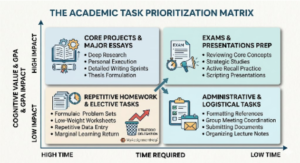
Every hour you spend at university carries an opportunity cost. If you spend five hours struggling through a repetitive, low-weight elective task, those are five hours you cannot spend studying for your major, building a portfolio, or resting.
| Task Type | Cognitive Value | Strategic Action |
| Core Major Projects | High | Deep focus, personal execution, professor feedback. |
| High-Weight Essays | High | Structural planning, extensive research, writing sprints. |
| Repetitive Problem Sets | Medium to Low | Process optimization, collaborative study, strategic delegation. |
| General Elective Homework | Low | Rapid execution, time-boxing, external assistance. |
As the table shows, not all academic tasks are created equal. Smart students prioritize tasks that directly impact their long-term career goals and find ways to streamline or delegate the rest.
Strategic Delegation and Academic Support
True academic efficiency means knowing when to ask for assistance. In the corporate world, managers delegate tasks to keep projects on track. As an undergraduate, you can use the same strategy to protect your academic standing when deadlines clash.
When technical problem sets, math proofs, or repetitive analytical reports consume all your evening hours, it makes sense to look for external support. Making the decision to utilize MyAssignmentHelp to pay people to do your homework allows you to hand off time-consuming, formulaic tasks to subject-matter experts. This ensures your weekly grades stay high while you dedicate your best mental energy to major exams, presentations, and core subjects that require your absolute focus.
Overcoming Procrastination Through Time-Blocking
Procrastination is rarely a reflection of laziness; it is an emotional response to an overwhelming task. When you face an assignment that feels too large to handle, your brain seeks immediate relief by distracting itself with low-priority activities. The best way to counter this loop is through structural time-blocking.
Time-blocking involves dividing your day into distinct chunks dedicated entirely to a single task. For example, instead of planning to “study chemistry all afternoon,” block out 2:00 PM to 3:30 PM specifically for writing the lab introduction. Once that block ends, move away from the desk. Knowing there is a definitive start and end time reduces the psychological dread of the assignment and helps build sustained momentum.
Maximizing Research Efficiency for Long-Form Papers
A significant portion of academic stress comes from poor research habits. Students often waste hours reading dense, hundred-page journal articles only to realize the text does not align with their thesis statement.
To optimize this process, learn how to skim academic papers strategically. Start by reading the abstract and the conclusion to verify if the study offers relevant data. If it does, skip directly to the methodology and key findings, looking for charts or bullet points that support your arguments. Take organized notes immediately, citing the source text as you go, so you do not have to hunt for forgotten URLs and book titles when compiling your final bibliography.
Building a Sustainable Academic Routine
Long-term university success requires consistency over intensity. Pulling all-nighters might help you clear an immediate deadline, but it damages your cognitive performance for the rest of the week.
To build a sustainable routine, establish clear boundaries for your study hours. Turn off digital distractions and treat your studies like a professional role. By removing the emotional stress of deadlines and replacing it with a predictable, manageable workflow, you ensure your university years are defined by academic growth rather than constant exhaustion.
Frequently Asked Questions
Q.1 How do I use the Agile framework if I have multiple deadlines in one week?
Ans: Map out all your deadlines on a single calendar to view the overlaps. Break each assignment down into micro-tasks and assign them to specific days leading up to the due date. Focus entirely on completing the day’s assigned tasks rather than worrying about the entire workload at once.
Q.2 Is delegating assignments a reliable way to protect my GPA?
Ans: Yes, when managed strategically. Delegating repetitive or secondary homework tasks allows you to balance a heavy course load. This keeps your grades consistent across all modules while giving you the necessary time to focus deeply on major exams and core projects.
Q.3 How can I improve my reading and research speed for major essays?
Ans: Avoid reading academic papers from back to front. Instead, read the abstract, introduction, and conclusion first to determine if the paper is relevant to your thesis. If it is, skim the methodologies and subheadings to locate the specific data points you need for your argument.
About The Author
I am Ruby Walker, a senior academic consultant and digital content strategist at MyAssignmentHelp. With over seven years of experience in higher education research and student workflow optimization, I specialize in developing practical frameworks that help undergraduates bridge the gap between complex academic theories and real-world efficiency.