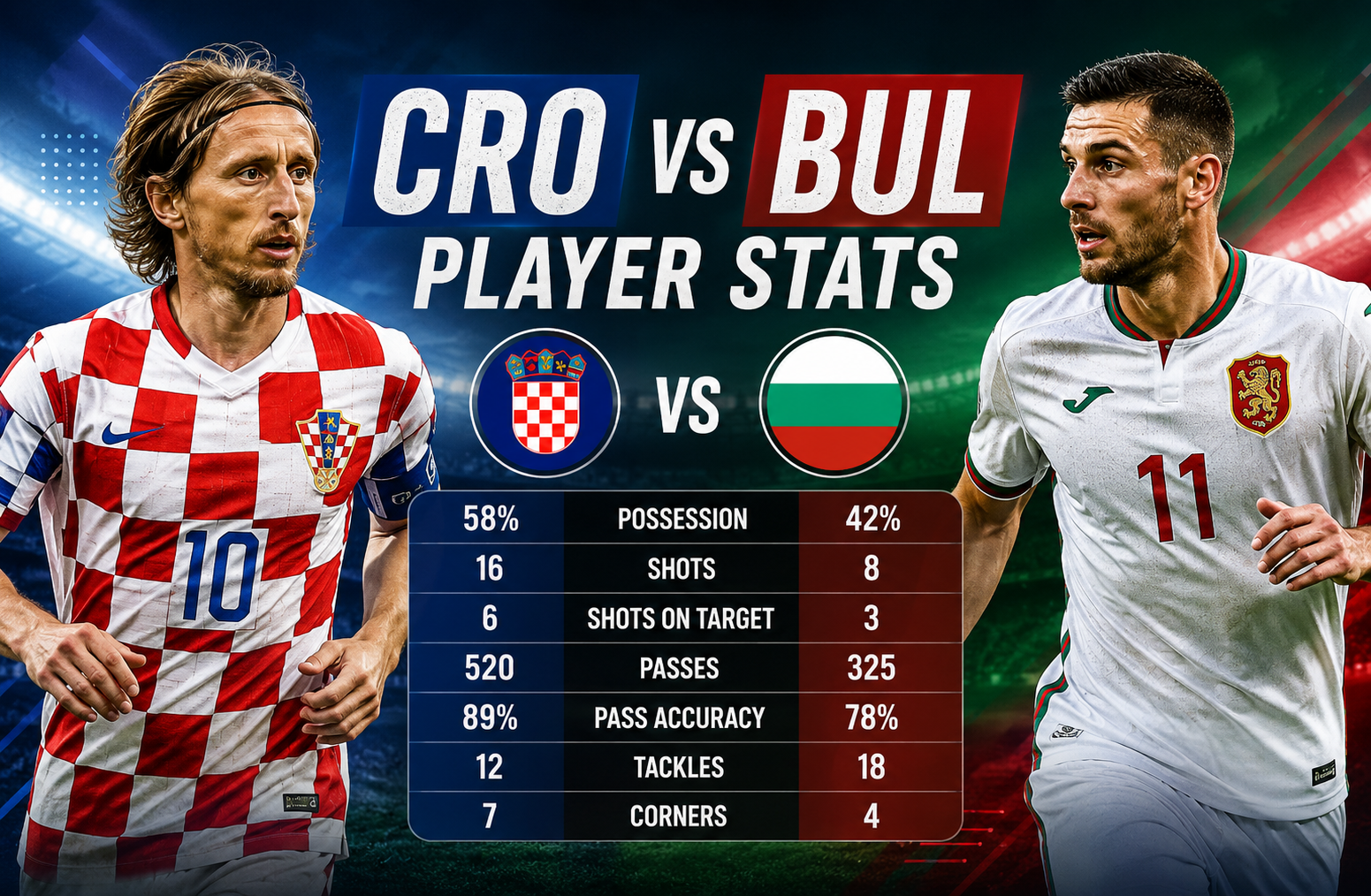
CRO vs BUL Player Stats
International football matches between Croatia national football team and Bulgaria national football team have always produced tactical battles filled with disciplined defending, creative midfield play, and moments of individual brilliance. Fans searching for CRO vs BUL Player Stats usually want more than a simple scoreline. They want to understand which players controlled possession, who created the biggest chances, how defensive systems performed, and which statistics truly shaped the result.
This detailed breakdown explores player performances, tactical patterns, advanced match numbers, and the deeper meaning behind the statistics from Croatia vs Bulgaria encounters. Instead of only listing numbers, this article explains how those numbers influence real football outcomes and what supporters, analysts, and fantasy football followers can learn from them.
Football statistics are far more valuable when paired with context. A midfielder completing 90 passes may sound impressive, but the real story lies in whether those passes broke defensive lines, controlled tempo, or created scoring opportunities. Likewise, defenders are not judged only by tackles. Positioning, interceptions, recovery runs, and aerial duels matter just as much.
Croatia vs Bulgaria Match Overview
Whenever Croatia and Bulgaria meet, the contrast in football identity becomes clear. Croatia traditionally focuses on technical midfield control, patient buildup play, and intelligent positional rotations. Bulgaria often relies on compact defensive organization and quick transitions through wide areas.
Recent encounters between these sides have highlighted several consistent patterns:
- Croatia dominating possession
- Bulgaria attempting structured counterattacks
- Midfield battles deciding momentum
- High passing accuracy from Croatian playmakers
- Bulgaria relying heavily on defensive discipline
The value of CRO vs BUL Player Stats becomes obvious when examining how each team approaches the game strategically rather than emotionally.
Why Player Stats Matter in Modern Football
Modern football analysis has changed dramatically over the last decade. Coaches, scouts, and analysts no longer rely only on goals and assists. Advanced metrics now help explain player influence more accurately.
Key reasons why player statistics matter include:
Tactical Understanding
Stats reveal whether a team succeeded with its tactical setup. For example:
- Possession percentage shows control
- Progressive passes show attacking intent
- Defensive duels indicate physical intensity
- Expected goals help measure chance quality
Performance Evaluation
A player may score once yet still perform poorly overall. Another player may not score but completely dominate midfield. Detailed statistics help separate perception from reality.
Scouting and Recruitment
National teams often monitor player data carefully before tournaments. Passing efficiency, pressing intensity, and defensive reliability help coaches choose starting lineups.
Fan Engagement
Supporters today want deeper insights. Simple scorelines are no longer enough. Fans analyze heat maps, pass networks, and defensive actions to understand matches better.
According to research published by Harvard Sports Analysis Collective, advanced football analytics continue to influence coaching decisions, player recruitment, and tactical preparation across elite competitions.
Key CRO vs BUL Player Stats Categories
Understanding football statistics requires knowing which categories matter most.
Goals and Assists
These remain the most visible numbers. However, context matters:
- Was the goal created through open play?
- Did the assist break defensive structure?
- Did the player contribute throughout the match?
Passing Accuracy
Passing accuracy helps measure composure and tactical discipline.
Typical benchmarks:
- 90%+ indicates elite control
- 80% to 89% suggests strong performance
- Below 75% may indicate risky or ineffective passing
Croatia traditionally performs exceptionally well in this category due to technically gifted midfielders.
Chances Created
This stat measures creativity and attacking influence. A player who creates multiple chances often impacts the game more than raw goal numbers suggest.
Defensive Actions
Important defensive metrics include:
- Tackles won
- Interceptions
- Clearances
- Blocks
- Recoveries
Bulgaria often depends heavily on these defensive numbers against stronger possession-based teams.
Distance Covered
Work rate matters significantly in international football. Midfielders frequently cover over 10 kilometers during intense matches.
Expected Goals
Expected goals, commonly called xG, measure the quality of scoring opportunities.
Higher xG generally means:
- Better attacking structure
- More dangerous chances
- Improved finishing opportunities
Midfield Battles That Shape the Match
One of the most fascinating aspects of CRO vs BUL Player Stats is the midfield comparison.
Croatia has historically relied on technically superior midfield control. Their midfielders typically dominate:
- Progressive passes
- Ball retention
- Tempo management
- Final-third entries
Bulgaria, meanwhile, often prioritizes:
- Defensive compactness
- Counterpressing
- Interceptions
- Quick vertical transitions
Croatia’s Midfield Strength
Croatian midfield systems are usually built around intelligent movement and passing triangles. Players often rotate positions fluidly, creating overloads that confuse defensive structures.
Key midfield statistics often include:
| Metric | Typical Croatia Advantage |
| Possession | Higher |
| Pass Completion | Higher |
| Progressive Passes | Higher |
| Final Third Entries | Higher |
| Chances Created | Higher |
Bulgaria’s Defensive Midfield Focus
Bulgaria frequently uses disciplined midfield screens to reduce space between defensive lines.
Important Bulgarian midfield strengths include:
- Ball recoveries
- Defensive shape
- Counterattack initiation
- Physical duels
This contrast creates a compelling tactical battle every time the teams meet.
Attacking Player Analysis
Attacking numbers are often the first thing fans check after international matches.
However, elite attacking analysis goes beyond goals.
Croatia’s Offensive Style
Croatia usually attacks through:
- Controlled possession
- Central combinations
- Overlapping fullbacks
- Late midfield runs
Their forwards often benefit from structured buildup rather than chaotic transitions.
Important attacking metrics include:
- Shots on target
- Expected assists
- Progressive carries
- Touches inside the box
Bulgaria’s Counterattacking Threat
Bulgaria often looks dangerous during transitions.
Their attackers typically rely on:
- Speed in open space
- Direct runs
- Wide attacking channels
- Quick passing combinations
This means Bulgaria may record fewer total shots but still produce dangerous opportunities.
Defensive Performance Breakdown
Defensive statistics frequently decide international matches more than attacking numbers.
Croatia’s Defensive Structure
Croatia generally focuses on:
- Positional discipline
- Ball recovery through pressing
- Intelligent defensive spacing
Key defensive stats often include:
- Interceptions
- Possession recoveries
- Pressing success
- Defensive duels won
Bulgaria’s Defensive Resilience
Bulgaria often spends long periods without possession against technically stronger opponents.
As a result, their defenders usually accumulate:
- High clearance numbers
- Numerous blocked shots
- Multiple aerial duel victories
These numbers reflect defensive workload rather than weakness alone.
Goalkeeper Statistics and Their Importance
Goalkeeper performance often shapes the final narrative of international football matches.
Important goalkeeper metrics include:
- Save percentage
- Goals prevented
- Distribution accuracy
- Crosses claimed
- Sweeper actions
Croatia Goalkeeping Analysis
Croatian goalkeepers usually contribute significantly to buildup play.
Modern football requires keepers to:
- Start attacks
- Play accurate long passes
- Remain calm under pressure
Bulgaria Goalkeeping Impact
Bulgarian goalkeepers often face higher shot volumes in difficult matches.
This creates opportunities for standout performances through:
- Reflex saves
- One on one situations
- Long-range shot stopping
Sometimes the best player in a match loses simply because football remains unpredictable.
Tactical Trends Seen in CRO vs BUL Player Stats
Patterns across multiple matches often reveal tactical truths.
Possession Control
Croatia frequently records:
- 55% to 65% possession
- Higher passing volume
- Better positional control
Transition Football
Bulgaria often focuses on:
- Quick recoveries
- Fast breaks
- Compact defensive lines
Width Usage
Croatia typically uses width methodically to stretch defenses.
Bulgaria usually stays narrower defensively to protect central zones.
These strategic differences heavily influence individual statistics.
Most Important Individual Metrics
Some statistics reveal true influence more accurately than others.
Progressive Passes
This metric measures forward passes that significantly advance attacking play.
Midfielders excelling here often control matches.
Progressive Carries
Carrying the ball forward under pressure creates space and disrupts defensive organization.
Press Resistance
Players who avoid losing possession under pressure become extremely valuable in international football.
Defensive Recoveries
Recovering loose balls quickly helps teams maintain structure and launch attacks.
How Analysts Interpret Match Statistics
Professional analysts rarely look at raw numbers alone.
Instead, they evaluate:
- Match context
- Tactical setup
- Opposition strength
- Game state
- Player roles
For example:
- A defender completing 40 passes may outperform another completing 80 if the defensive role was more difficult.
- A striker with fewer touches may still perform effectively through movement and pressing.
This deeper interpretation separates elite analysis from casual observation.
Fitness and Physical Output
Modern football is physically demanding.
Important physical metrics include:
- Sprint count
- Distance covered
- High intensity runs
- Recovery speed
Croatia’s Physical Approach
Croatia often balances technical quality with intelligent energy management.
Their players usually:
- Press selectively
- Maintain tactical shape
- Avoid unnecessary running
Bulgaria’s Work Rate
Bulgaria frequently relies on:
- Aggressive defensive tracking
- High recovery effort
- Compact movement patterns
Physical statistics often reveal which team controlled the emotional and tactical rhythm of the match.
Young Players to Watch
One interesting aspect of CRO vs BUL Player Stats is identifying emerging talents.
Young players are often judged by:
- Passing confidence
- Decision-making
- Defensive awareness
- Movement off the ball
International matches provide enormous developmental experience because the tactical intensity is much higher than many club environments.
Common Misunderstandings About Football Stats
Football statistics can sometimes mislead fans.
Possession Does Not Guarantee Dominance
A team may control possession without creating quality chances.
More Shots Do Not Always Mean Better Attacking
Shot quality matters more than quantity.
Defensive Numbers Need Context
A defender with many clearances may simply face more pressure.
Passing Accuracy Can Be Misleading
Safe sideways passes inflate completion percentages without improving attacking play.
Understanding these nuances helps fans interpret player stats more intelligently.
Comparing Historical Trends
Historical comparisons reveal how football evolves.
Earlier Matches
Older Croatia vs Bulgaria encounters often featured:
- Slower buildup
- Less pressing intensity
- More direct play
Modern Matches
Recent matches show:
- Faster transitions
- Advanced pressing systems
- Tactical fluidity
- Increased data-driven preparation
This evolution has changed how analysts interpret player statistics.
Fantasy Football and Statistical Value
Fantasy football users often analyze international matches carefully.
Important fantasy-related metrics include:
- Goal involvement
- Key passes
- Shots on target
- Tackles won
- Clean sheets
Croatian midfielders often offer strong all-around value because they contribute across multiple categories.
Bulgarian defenders sometimes provide value through:
- Clearances
- Interceptions
- Defensive work rate
Lessons Coaches Can Learn From These Matches
Coaches often study international matches to understand tactical adaptability.
Important lessons include:
Ball Retention Under Pressure
Croatia often demonstrates how technical midfielders can control difficult moments.
Defensive Compactness
Bulgaria frequently shows how disciplined structure can limit stronger opponents.
Transition Efficiency
Quick attacking transitions remain one of the most dangerous weapons in modern football.
Game Management
International football rewards teams that remain emotionally composed during momentum swings.
Statistical Areas That Usually Decide the Result
Across many Croatia vs Bulgaria matches, several categories consistently influence outcomes.
Key Deciding Factors
- Midfield passing control
- Defensive transitions
- Chance conversion efficiency
- Set piece effectiveness
- Goalkeeper performance
These areas often matter more than total possession or total shots.
How Fans Should Read Player Stats
Fans can improve their football understanding by analyzing statistics more thoughtfully.
Instead of focusing only on goals:
- Watch passing patterns
- Observe pressing intensity
- Notice defensive spacing
- Evaluate movement without the ball
The best football analysis combines numbers with tactical observation.
Future of Football Analytics
Football analytics continues evolving rapidly.
Emerging technologies now track:
- Player positioning
- Sprint acceleration
- Passing lanes
- Defensive pressure
- Spatial control
Future CRO vs BUL Player Stats will likely become even more detailed and interactive.
Artificial intelligence and machine learning are also helping analysts identify tactical patterns faster than ever before.
FAQs
What does CRO vs BUL Player Stats mean?
It refers to statistical analysis from matches between Croatia and Bulgaria, including goals, assists, passing accuracy, defensive actions, and advanced performance metrics.
Which statistics matter most in football analysis?
The most valuable stats usually include expected goals, chances created, progressive passes, defensive recoveries, and passing efficiency.
Why is Croatia often strong statistically?
Croatia traditionally develops technically gifted midfielders who excel in possession control, passing accuracy, and tactical intelligence.
Why do Bulgaria defenders often record high numbers?
Bulgaria frequently defends deeply against stronger possession teams, leading to more clearances, interceptions, and defensive duels.
Are football statistics always accurate indicators of performance?
No. Statistics require context. Tactical roles, match situations, and opposition quality all influence the meaning of numbers.
How do analysts use player stats professionally?
Analysts combine statistics with video review to evaluate tactical systems, player influence, and overall team effectiveness.
Conclusion
The deeper you explore football data, the more fascinating international matches become. CRO vs BUL Player Stats reveal far more than a scoreboard ever could. They show tactical discipline, technical quality, physical intensity, and the subtle details that decide elite football matches.
Croatia typically demonstrates control through possession and midfield intelligence, while Bulgaria often relies on structure, resilience, and transition efficiency. These contrasting styles create compelling statistical narratives that help analysts, coaches, fantasy football players, and supporters understand the game on a deeper level.
Modern football analysis is no longer just about goals and assists. Passing networks, defensive recoveries, pressing systems, and expected goals now shape how experts evaluate performance. Understanding these elements transforms the viewing experience and offers a clearer picture of how matches are truly won and lost.