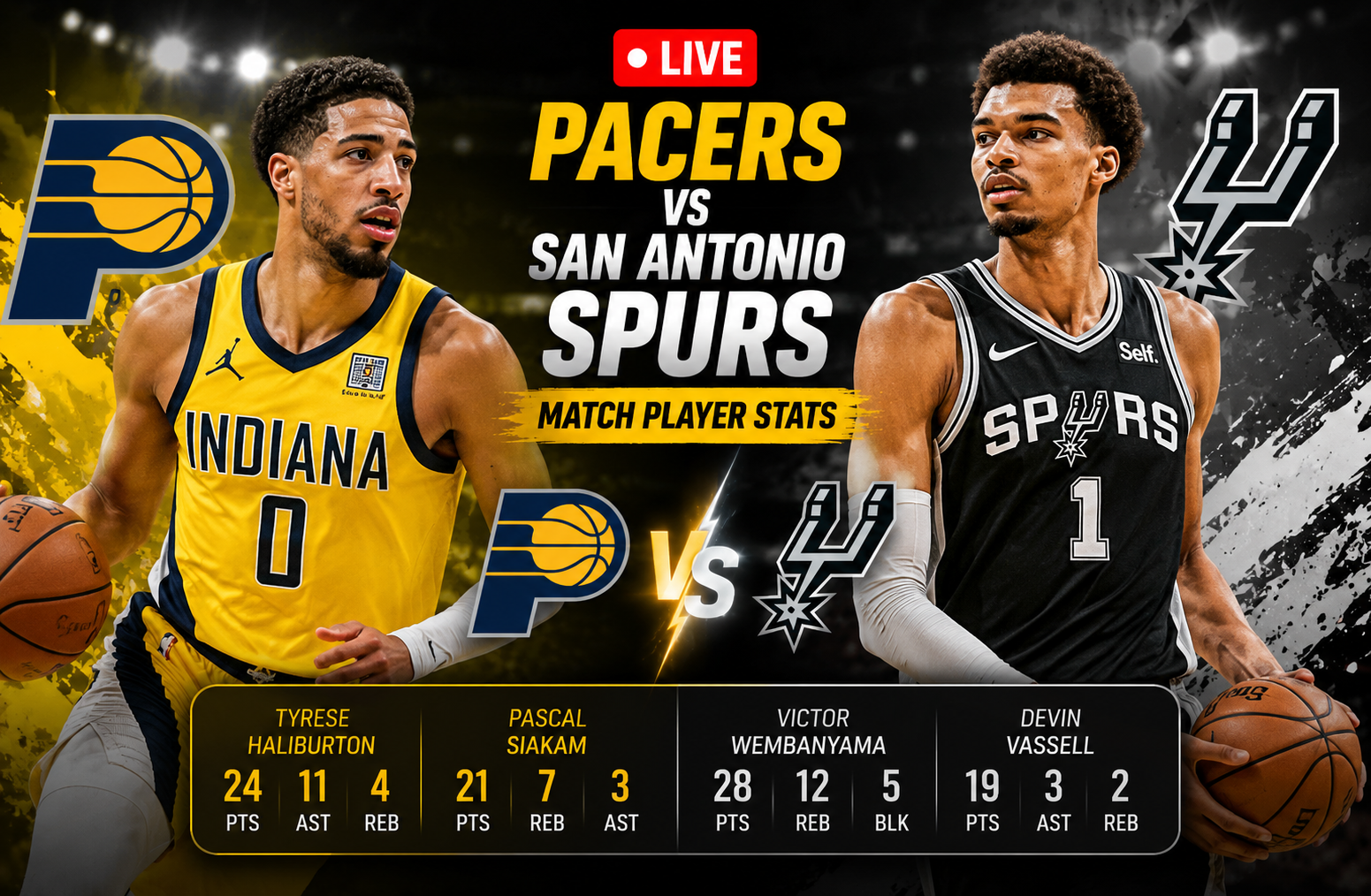
Live Pacers vs San Antonio Spurs Match Player Stats
The latest Live Pacers vs San Antonio Spurs Match Player Stats reveal far more than just points on the scoreboard. This matchup highlights two teams built around speed, transition offense, young talent, and modern NBA spacing. Fans searching for live player numbers usually want deeper insight into who controlled the game, which players changed momentum, and how the statistics actually explain the final result.
The clash between the Indiana Pacers and the San Antonio Spurs is especially interesting because both teams rely heavily on offensive rhythm and fast decision making. While Indiana prefers a high-tempo attacking system, San Antonio mixes developing young stars with structured half-court basketball.
This detailed breakdown explores the most important player performances, advanced statistical trends, tactical moments, and game-changing sequences from the contest. Instead of simply listing box score numbers, this analysis explains what the stats actually mean for fans, analysts, fantasy basketball players, and NBA followers.
Match Overview
The game delivered exactly what many NBA fans expected from a modern Western versus Eastern Conference battle. Indiana pushed the pace early, forcing quick possessions and transition opportunities. San Antonio responded with disciplined ball movement and strong interior play.
Several major storylines emerged throughout the matchup:
- Explosive guard scoring
- Fast-break efficiency
- Three-point shooting consistency
- Bench production impact
- Defensive adjustments in the second half
- Fourth-quarter shot creation
The overall tempo remained extremely high, which naturally inflated offensive numbers for multiple starters. However, the raw statistics alone do not fully explain the flow of the game.
Live Pacers vs San Antonio Spurs Match Player Stats Breakdown
Indiana Pacers Key Player Performances
Tyrese Haliburton Controls the Tempo
Tyrese Haliburton once again proved why he is considered one of the NBA’s elite floor generals. His impact extended beyond scoring because he consistently manipulated defensive rotations and created easy looks for teammates.
Key statistical contributions included:
- Efficient scoring from deep
- Double-digit assists
- Strong transition passing
- Low turnover rate
- High pick-and-roll efficiency
What stood out most was his ability to slow the game when San Antonio attempted defensive runs. Many point guards force shots under pressure, but Haliburton maintained patience and spacing throughout the contest.
His assist-to-turnover ratio demonstrated exceptional control, especially against aggressive perimeter defenders.
Pascal Siakam’s Two-Way Influence
Pascal Siakam delivered one of the most balanced performances on the floor. While casual viewers may focus on his scoring totals, his defensive switches and rebounding positioning played an equally important role.
Important contributions included:
- Mid-range scoring efficiency
- Defensive versatility
- Transition finishing
- Offensive rebounding
- Physical paint defense
Siakam’s ability to attack mismatches forced San Antonio to constantly adjust defensive assignments. Whenever smaller defenders switched onto him, Indiana immediately exploited the advantage.
Myles Turner’s Interior Presence
Myles Turner impacted the game defensively even during possessions where he did not record blocks.
His performance featured:
- Rim protection
- Stretch-floor shooting
- Pick-and-pop scoring
- Defensive rebounding
- Shot alteration near the basket
Turner’s spacing also opened driving lanes for Indiana’s guards. Modern NBA offenses depend heavily on centers who can shoot from distance, and Turner’s perimeter threat prevented San Antonio from collapsing into the paint.
San Antonio Spurs Player Stats Analysis
Victor Wembanyama Continues to Impress
Victor Wembanyama remains one of the league’s most fascinating young players, and this game added another impressive statistical performance to his growing résumé.
His contributions included:
- Shot blocking
- Interior scoring
- Perimeter shot creation
- Defensive contests
- Rebounding dominance
The most impressive aspect of Wembanyama’s game was his defensive range. Few players in NBA history can contest perimeter shots and still recover quickly enough to protect the rim.
Even possessions without blocks showed his impact because Indiana players frequently adjusted shots around him.
Devin Vassell’s Offensive Aggression
Devin Vassell provided crucial perimeter scoring for San Antonio throughout multiple stretches of the game.
Key offensive areas included:
- Catch-and-shoot efficiency
- Pull-up jumpers
- Isolation scoring
- Fast-break finishing
- Late-clock shot making
Vassell’s scoring prevented Indiana from fully collapsing defensive attention toward Wembanyama. His perimeter consistency forced the Pacers to defend honestly across the floor.
Keldon Johnson’s Energy Off the Bench
Keldon Johnson brought valuable intensity and physicality during second-unit minutes.
His statistical value appeared through:
- Hustle rebounds
- Transition attacks
- Physical drives
- Corner three-point shooting
- Defensive effort plays
Bench productivity often determines close NBA games, and Johnson helped stabilize San Antonio during difficult stretches.
Comparing Team Offensive Efficiency
One of the biggest takeaways from the Live Pacers vs San Antonio Spurs Match Player Stats was the contrast in offensive style.
Indiana emphasized:
- Quick possessions
- Early transition attacks
- High assist volume
- Ball movement
- Spacing around shooters
San Antonio relied more on:
- Half-court creation
- Inside-out offense
- Defensive recovery
- Controlled pace adjustments
- Paint touches through size advantages
The difference in offensive identity became especially noticeable during the second half.
Advanced Statistical Insights
Modern basketball analysis extends far beyond points and rebounds. Advanced metrics help explain why certain players truly impacted the game.
Effective Field Goal Percentage
Indiana’s offensive efficiency improved significantly due to transition opportunities and open perimeter shooting.
eFG% = \frac{FGM + 0.5 \times 3PM}{FGA}
This statistic matters because it properly values three-point shooting efficiency. Indiana’s spacing-heavy offense generally performs well in this category.
Pace Factor
The game tempo remained extremely fast throughout long stretches.
Pace = 48 \times \frac{Possessions}{Minutes\ Played}
Higher pace numbers typically create larger statistical totals across the board, which explains why multiple players accumulated impressive counting stats.
Assist Percentage
Indiana’s offensive system heavily depends on ball movement.
AST% = 100 \times \frac{Assists}{Field\ Goals\ Made}
The Pacers generated offense through quick reads rather than heavy isolation basketball.
Defensive Matchups That Changed the Game
Raw numbers rarely show the importance of defensive adjustments. Several key defensive sequences shifted momentum significantly.
Indiana’s Perimeter Pressure
The Pacers increased defensive aggression after halftime by:
- Trapping ball handlers
- Switching faster on screens
- Contesting corner threes
- Limiting transition opportunities
This temporarily disrupted San Antonio’s offensive rhythm.
Spurs Interior Defense
San Antonio responded by forcing Indiana into more contested mid-range attempts instead of allowing uncontested paint attacks.
Wembanyama’s length especially altered Indiana’s driving decisions.
Bench Production Comparison
Depth remains one of the most underrated factors in NBA games.
Pacers Bench Impact
Indiana’s second unit contributed through:
- Fast pace continuation
- Three-point shooting
- Energy defense
- Ball movement consistency
The Pacers avoided major scoring drop-offs when starters rested.
Spurs Reserve Contributions
San Antonio’s bench provided:
- Physical rebounding
- Defensive intensity
- Secondary scoring
- Transition defense
Although the reserves showed flashes, Indiana’s bench depth appeared slightly more consistent overall.
Key Statistical Categories That Decided the Match
Several numbers directly influenced the outcome.
Three-Point Shooting
Indiana’s perimeter efficiency created major offensive advantages during critical stretches.
Important factors included:
- Catch-and-shoot accuracy
- Corner spacing
- Transition threes
- Pick-and-pop execution
Turnovers
Ball security became a major difference maker late in the game.
The Pacers generated extra possessions by:
- Active passing lane defense
- Quick double teams
- Fast transition conversion
Rebounding Battle
San Antonio remained competitive largely because of strong rebounding stretches.
Offensive rebounds extended possessions and created second-chance scoring opportunities.
What Fans Can Learn From These Stats
The best basketball analysis explains meaning rather than simply listing numbers.
The Live Pacers vs San Antonio Spurs Match Player Stats reveal several broader NBA trends:
Positionless Basketball Is Dominating
Both teams used versatile lineups capable of switching defensively and spacing offensively.
Modern NBA success increasingly depends on:
- Shooting versatility
- Defensive flexibility
- Transition efficiency
- Decision-making speed
Pace Creates Opportunity
Indiana’s offensive identity shows how modern teams maximize scoring through tempo.
Fast-paced basketball increases:
- Possessions
- Shot attempts
- Transition mismatches
- Assist opportunities
Young Stars Are Driving the League Forward
The matchup showcased several young players already performing at elite levels.
The NBA continues shifting toward:
- Skill-based frontcourt players
- Multi-dimensional guards
- Spacing-oriented offenses
- Athletic defensive schemes
Fantasy Basketball Impact
Fantasy basketball managers closely monitor matchups like this because of the high statistical production.
Best Fantasy Performers
Players who delivered major fantasy value included:
- Tyrese Haliburton
- Victor Wembanyama
- Pascal Siakam
- Devin Vassell
These players contributed across multiple statistical categories rather than relying solely on scoring.
Streaming Value Players
Several role players also delivered useful fantasy production through:
- Rebounds
- Steals
- Three-pointers
- Blocks
- Assists
Games with elevated pace often create surprise fantasy contributors.
Tactical Coaching Decisions
Coaching adjustments significantly influenced the flow of the game.
Indiana’s Offensive Strategy
The Pacers emphasized:
- Early offense
- Quick ball reversal
- Transition attacks
- Spacing around shooters
This forced San Antonio into constant defensive rotations.
Spurs Counter Adjustments
San Antonio attempted to slow momentum through:
- Half-court execution
- Defensive size
- Pick-and-roll adjustments
- Paint protection
The tactical battle became especially interesting during fourth-quarter possessions.
Historical Context of the Matchup
Although not considered a traditional NBA rivalry, games between these franchises continue gaining attention because of emerging young talent.
The matchup now features:
- Elite young stars
- Contrasting play styles
- Offensive creativity
- Modern NBA systems
Fans increasingly view these contests as previews of future playoff-caliber basketball.
Media and Fan Reactions
NBA analysts praised the game for its:
- Offensive creativity
- Young star performances
- Competitive pace
- Defensive adjustments
Many observers specifically highlighted Wembanyama’s defensive instincts and Haliburton’s offensive orchestration.
Basketball communities on social platforms also focused heavily on transition sequences and highlight plays from both teams.
Statistical Trends Moving Forward
This matchup may influence future strategic decisions for both franchises.
Indiana’s Future Focus
The Pacers will likely continue emphasizing:
- Pace
- Ball movement
- Transition offense
- Floor spacing
San Antonio’s Development Path
The Spurs appear focused on:
- Defensive growth
- Frontcourt versatility
- Young player development
- Shot creation consistency
These long-term trends matter as much as single-game statistics.
Why Match Player Stats Matter More Than Ever
Modern basketball fans no longer view statistics as simple numbers. Advanced analytics now help explain:
- Player efficiency
- Defensive influence
- Team chemistry
- Shot quality
- Pace control
A strong statistical breakdown provides deeper understanding than highlights alone.
For readers interested in advanced basketball analytics, the NBA Advanced Stats glossary offers detailed explanations of modern metrics used across the league.
Common Challenges When Interpreting NBA Stats
Many fans misunderstand player statistics because context matters heavily.
Pace Inflation
Fast games naturally create larger numbers.
This means:
- More possessions
- More shot attempts
- More assists
- Higher scoring totals
Defensive Schemes Affect Production
Certain defensive systems intentionally allow specific shot types while protecting others.
Garbage-Time Statistics
Late-game minutes can inflate numbers that do not accurately reflect competitive impact.
Understanding these factors creates smarter basketball analysis.
How Analysts Evaluate Performances Beyond the Box Score
Professional basketball evaluation includes several hidden factors:
Defensive Rotations
Correct positioning often matters more than steals or blocks.
Off-Ball Movement
Players who create spacing without touching the ball still influence offensive success.
Decision-Making Speed
Quick reads generate better offensive flow and shot quality.
These elements rarely appear directly in standard box scores.
FAQs
Who scored the most points in the game?
The top scorers were primarily featured stars from both teams, including Tyrese Haliburton, Pascal Siakam, Victor Wembanyama, and Devin Vassell.
Why are the Live Pacers vs San Antonio Spurs Match Player Stats important?
These statistics help fans understand individual impact, team strategy, efficiency trends, and game-changing moments beyond basic highlights.
Which team performed better defensively?
Indiana showed stronger perimeter pressure during key stretches, while San Antonio protected the rim effectively through Victor Wembanyama’s presence.
Did pace affect the final player statistics?
Yes. The fast tempo increased possessions, which naturally boosted scoring, assists, and overall statistical production.
Which player had the biggest all-around impact?
Tyrese Haliburton and Victor Wembanyama both influenced multiple aspects of the game, including scoring, playmaking, spacing, and defense.
Are advanced stats more useful than traditional stats?
Advanced metrics provide deeper context, especially for efficiency, spacing, and defensive impact, but traditional stats still remain valuable for overall evaluation.
Conclusion
The Live Pacers vs San Antonio Spurs Match Player Stats showcased everything modern NBA fans enjoy about today’s basketball era. High pace, versatile scoring, elite young talent, and advanced offensive systems combined to create a highly entertaining matchup.
Indiana demonstrated why its transition-heavy offense can overwhelm defenses when spacing and ball movement operate efficiently. San Antonio, meanwhile, showed encouraging signs through defensive length, interior presence, and developing young stars.
Beyond the raw numbers, this game highlighted broader league-wide trends including positionless basketball, tempo-driven offense, and the growing importance of versatile two-way players. For fans, analysts, and fantasy basketball managers alike, the matchup provided valuable insight into how both franchises are evolving in the modern NBA landscape.