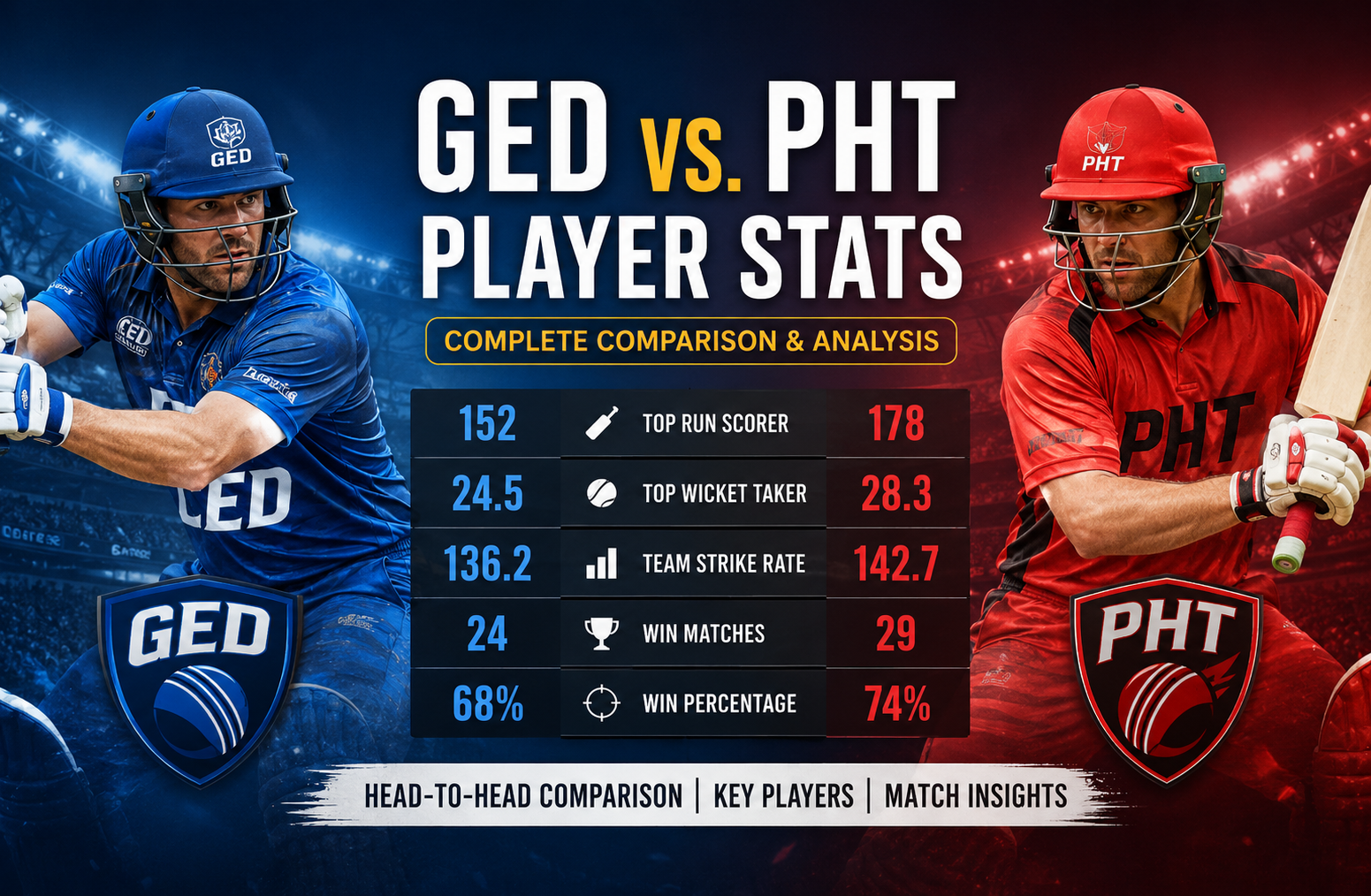
GED vs. PHT Player Stats
GED vs. PHT Player Stats continue to attract attention among cricket fans who closely follow domestic league competitions and emerging talent from the UAE cricket circuit. Matches between Gems Education CC and Prim Height Transport have delivered explosive batting, aggressive bowling spells, and fantasy cricket opportunities that deserve deeper analysis beyond a simple scorecard.
This detailed guide explores player performances, batting records, bowling impact, tactical matchups, head to head trends, fantasy insights, and statistical patterns from recent encounters between these teams. The aim is to provide a complete informational resource that helps readers understand how the contest unfolded, which players influenced the outcome, and what the numbers actually reveal.
Understanding the GED vs. PHT Rivalry
GED represents Gems Education CC while PHT stands for Prim Height Transport. Both teams have competed in UAE based domestic cricket tournaments, including short format events that reward aggressive batting and quick tactical decisions.
Although this rivalry does not yet carry the global attention of international cricket, it has become increasingly popular among fantasy cricket players, regional cricket followers, and statistical analysts. One reason is the unpredictable nature of the contests. Another is the presence of players capable of producing explosive innings in limited overs.
The Sharjah Cricket Stadium has often played a major role in shaping the outcome of these matches. The venue traditionally supports stroke play, especially during shorter formats where power hitting becomes a decisive factor.
GED vs. PHT Player Stats Overview
When reviewing GED vs. PHT Player Stats, several clear trends stand out:
- GED have often displayed stronger top order batting depth
- PHT have depended heavily on a few consistent run scorers
- Bowling performances have fluctuated significantly between matches
- Strike rates have generally been very high because of the format
- Powerplay overs have frequently determined momentum
These patterns help explain why some matches became one sided while others remained competitive.
Recent Match Summary Between GED and PHT
One of the most discussed encounters ended with GED scoring 223 without losing a wicket. PHT responded with 146 all out in 17 overs.
That match became memorable for several reasons:
- GED produced a dominant batting display
- Two batters scored unbeaten centuries
- PHT struggled to control the run rate
- The pressure of chasing a massive target led to frequent wickets
The scoreline highlighted the gap in execution between the two sides on that occasion.
Top Batting Performers From GED
Shahan Akram
Shahan Akram delivered one of the most destructive innings in the rivalry. His unbeaten 108 runs from 53 balls combined timing, power, and intelligent strike rotation.
Key highlights from the innings included:
- 9 sixes
- Strike rate above 200
- Excellent control against pace bowling
- Aggressive acceleration during middle overs
What made the knock special was the balance between risk and control. Instead of swinging wildly, he targeted specific areas and punished loose deliveries.
His approach showed the importance of game awareness in shorter formats. Rather than attacking every ball, he built momentum gradually before dominating the death overs.
Muhammad Anwar Khan
Muhammad Anwar Khan also crossed the century mark in the same match, remaining unbeaten on 100 from 48 deliveries.
His innings complemented Shahan Akram perfectly.
Important aspects of his batting included:
- Fast running between wickets
- Efficient boundary placement
- Consistent pressure on bowlers
- Minimal dot balls
Together, both players created a partnership that completely changed the match.
Dawood Ejaz
Dawood Ejaz has consistently been one of the dependable batters for GED across multiple tournaments.
His statistical profile shows:
- Strong average in short format cricket
- Ability to score quickly against pace
- Better numbers while batting first
- Reliable powerplay scoring rate
He may not always produce headlines, but his stability adds balance to the batting lineup.
Taimoor Ali
Taimoor Ali remains another important contributor.
His strengths include:
- Positive intent during the opening overs
- High strike rotation percentage
- Ability to attack spin bowling
- Flexibility in different batting positions
In shorter formats, players like Taimoor Ali are extremely valuable because they help maintain scoring momentum even when boundaries are not flowing.
Top Batting Performers From PHT
Abdul Shakoor
Abdul Shakoor has often been the standout batter for PHT.
His recent performances reveal:
- Multiple scores above 40
- Consistent strike rate
- Strong attacking ability against fast bowling
- Good boundary conversion percentage
He has shown the ability to anchor innings while still maintaining scoring momentum.
One reason fantasy cricket users prefer him is his consistency. Even when PHT struggle collectively, Abdul Shakoor usually contributes meaningful runs.
Amjad Khan
Amjad Khan has produced several useful innings in middle order situations.
His batting style focuses on:
- Aggressive intent against spin
- Fast acceleration after settling in
- Strong hitting square of the wicket
- Smart placement during field restrictions
However, one weakness has been inconsistency against disciplined bowling attacks.
Fahad Nawaz
Fahad Nawaz offers value as an all round option.
He contributes through:
- Useful middle order runs
- Part time spin bowling
- Fielding impact
- Tactical flexibility
All rounders become particularly important in short format cricket because they improve balance without reducing batting depth.
Bowling Analysis for GED
Bilal Akbar
Bilal Akbar has emerged as one of the most effective wicket taking bowlers for GED.
His bowling record demonstrates:
- Strong wicket taking consistency
- Effective variations
- Ability to bowl in pressure overs
- Control against attacking batters
Left arm spin has frequently troubled aggressive hitters in these contests, especially when batters attempt to force the pace too early.
Muhammad Ali
Muhammad Ali has impressed with his pace bowling contributions.
His strengths include:
- Hard lengths
- Wicket taking ability during middle overs
- Useful slower deliveries
- Positive economy rate under pressure
Fast bowlers who can disguise pace changes usually perform well at Sharjah because batters often premeditate attacking shots.
Ali Afridi
Ali Afridi has delivered important breakthroughs in several games.
He is particularly effective when:
- Bowling to right handed batters
- Operating during middle overs
- Targeting larger boundary dimensions
- Building pressure through dot balls
His control helps create wicket opportunities from the opposite end.
Bowling Analysis for PHT
Jasim Jawad Hussain
Jasim Jawad Hussain has shown encouraging wicket taking ability.
His performances indicate:
- Ability to strike with the new ball
- Useful seam movement
- Strong attacking mindset
- Better performances in second innings
Despite these positives, he has occasionally struggled with economy rates when batters attack aggressively.
Muhammad Irfan
Muhammad Irfan has contributed with disciplined pace bowling.
Key observations include:
- Consistent line and length
- Better control in powerplay overs
- Ability to force mistimed shots
- Useful defensive bowling under pressure
In short formats, even a few economical overs can significantly shift match momentum.
Riaz Khaliq
Riaz Khaliq provides spin variation and tactical control.
His effectiveness depends heavily on:
- Pitch conditions
- Batter matchups
- Field placements
- Game situation
When conditions assist slower bowlers, he becomes a difficult player to attack.
Head to Head Statistical Trends
Head to head data reveals several interesting trends between the teams.
GED Batting Dominance
GED have generally produced stronger totals in direct meetings.
Reasons include:
- Better top order partnerships
- More consistent strike rates
- Greater batting depth
- Improved finishing ability
The ability to maintain scoring momentum throughout the innings has separated GED from PHT in several contests.
PHT Dependence on Key Players
PHT have often relied heavily on a smaller group of performers.
This creates pressure because:
- Early wickets expose the middle order
- Run scoring slows significantly after key dismissals
- Lower order recovery becomes difficult
- Chase management weakens under scoreboard pressure
Teams with broader batting contributions usually perform better in modern short format cricket.
Impact of Powerplay Overs
Powerplay overs have repeatedly shaped match results.
When GED start aggressively, they become extremely difficult to stop.
When PHT lose early wickets, recovery becomes challenging because required run rates rise quickly.
This pattern highlights the importance of intent during the opening overs.
Fantasy Cricket Insights
Fantasy cricket users frequently search for detailed player analysis before matches.
Based on historical performances, the following players have offered strong fantasy value:
Best Captain Choices
- Shahan Akram
- Abdul Shakoor
- Muhammad Anwar Khan
These players combine high scoring potential with consistency.
Best Vice Captain Options
- Bilal Akbar
- Dawood Ejaz
- Fahad Nawaz
These selections often provide balanced fantasy returns.
Differential Picks
- Ali Afridi
- Muhammad Ali
- Jasim Jawad Hussain
Differential players become valuable when they contribute unexpectedly with wickets or quick runs.
Tactical Lessons From GED vs PHT Matches
Aggressive Batting Wins Games
Modern short format cricket rewards teams willing to attack early.
GED have demonstrated this clearly through:
- High powerplay strike rates
- Positive intent against spin
- Efficient boundary hitting
- Reduced dot ball percentage
The statistical evidence strongly supports proactive batting strategies.
Bowling Variations Matter
Teams that rely only on pace often struggle on batting friendly surfaces.
Successful bowlers in these contests usually use:
- Slower balls
- Wide yorkers
- Spin variations
- Pace changes
Variation disrupts rhythm and forces errors.
Partnerships Decide Momentum
Large partnerships have repeatedly shifted matches.
The unbeaten century stand by Shahan Akram and Muhammad Anwar Khan remains the best example.
Strong partnerships achieve several goals:
- Reduce pressure
- Allow controlled acceleration
- Prevent exposure of weaker middle order batters
- Force defensive field placements
Sharjah Cricket Stadium Influence
Venue conditions significantly impact player performance.
Sharjah generally offers:
- Fast outfield
- Short boundaries
- Favorable batting conditions
- High scoring opportunities
Because of these characteristics, batters with clean power hitting techniques usually succeed.
However, bowlers who vary pace intelligently can still create opportunities.
Key Statistical Categories Explained
Many readers searching for GED vs. PHT Player Stats want to understand how cricket statistics should actually be interpreted.
Strike Rate
Strike rate measures scoring speed.
For batters:
- Higher strike rates indicate aggressive scoring
- Rates above 150 are usually excellent in short formats
- Context matters depending on match situation
For bowlers, economy rate often becomes more important than wickets.
Economy Rate
Economy rate reflects runs conceded per over.
A bowler with:
- Strong economy can control momentum
- Tight overs can create scoreboard pressure
- Defensive consistency often produces wickets indirectly
Average
Batting average measures consistency.
However, averages in short format cricket must be evaluated alongside strike rates.
A batter scoring quickly at moderate average may still be more valuable than a slow scoring batter with a higher average.
Most Memorable Individual Performances
Best Batting Performance
Shahan Akram’s unbeaten century remains one of the defining innings in this rivalry.
Why it mattered:
- Exceptional strike rate
- Match winning impact
- Pressure free finishing
- Dominance against multiple bowlers
Best Bowling Spell
Bilal Akbar’s wicket taking performances have frequently shifted momentum.
His ability to break partnerships has proven highly valuable.
Best Partnership
The century partnership between Shahan Akram and Muhammad Anwar Khan completely changed match dynamics.
It demonstrated:
- Communication
- Shot selection
- Match awareness
- Controlled aggression
Areas Where PHT Need Improvement
Although PHT possess talented players, certain weaknesses continue to appear.
Middle Order Stability
The middle order has occasionally struggled under pressure.
Improvement areas include:
- Strike rotation
- Recovery after early wickets
- Handling spin bowling
- Building partnerships
Death Over Bowling
Conceding too many runs in the final overs has hurt PHT repeatedly.
Possible solutions include:
- Better yorker execution
- Improved slower ball variations
- Smarter field settings
- Role clarity among bowlers
Fielding Standards
Fielding can significantly influence short format matches.
Dropped catches and misfields often increase pressure on bowlers.
Sharper fielding could help PHT compete more effectively against aggressive batting lineups.
Why GED Have Been More Successful
GED appear better balanced in several areas.
Strong Top Order
Their opening combinations consistently provide solid starts.
Multiple Match Winners
Unlike teams that depend heavily on one player, GED possess several players capable of influencing outcomes.
Better Momentum Control
GED often manage game momentum more effectively through:
- Controlled aggression
- Smart bowling changes
- Consistent partnerships
- Efficient chase management
What Makes These Matches Interesting for Fans
Even though this rivalry belongs to domestic cricket, it remains entertaining because:
- Batters score quickly
- Matches contain momentum swings
- Emerging players gain visibility
- Fantasy cricket involvement increases interest
Domestic leagues also provide important development opportunities for players seeking higher level recognition.
Statistical Comparison Between Key Players
| Player | Team | Strength | Major Impact |
| Shahan Akram | GED | Power hitting | Match winning centuries |
| Muhammad Anwar Khan | GED | Consistency | Stable top order scoring |
| Abdul Shakoor | PHT | Aggressive batting | Reliable run production |
| Bilal Akbar | GED | Spin bowling | Middle over wickets |
| Fahad Nawaz | PHT | All round skills | Balance and flexibility |
| Dawood Ejaz | GED | Controlled batting | Consistent starts |
Lessons for Fantasy Cricket Players
Fantasy cricket users should avoid selecting players only based on reputation.
Important factors include:
- Venue conditions
- Batting position
- Recent form
- Bowling role
- Match situation trends
For example, top order batters generally receive more scoring opportunities than lower order players.
Similarly, bowlers operating during powerplay and death overs often have greater wicket taking potential.
The Role of Momentum in Short Format Cricket
Momentum shifts happen rapidly in limited overs matches.
A single over can completely change outcomes.
GED have often controlled momentum through aggressive batting partnerships, while PHT have occasionally struggled to recover after difficult overs.
Understanding momentum is important because statistics alone do not always explain why matches unfold a certain way.
How Data Helps Modern Cricket Analysis
Cricket analysis has evolved significantly.
Modern analysts study:
- Wagon wheels
- Strike rotation percentages
- Boundary frequency
- Matchup statistics
- Bowling phase effectiveness
These deeper metrics provide more accurate insights than traditional scorecards.
For example, a batter scoring 40 from 20 balls may influence a match more heavily than a batter scoring 60 from 55 deliveries.
Emerging Players to Watch
Several players from these teams have shown potential for future growth.
Players From GED
- Shahan Akram
- Muhammad Ali
- Ali Afridi
Players From PHT
- Abdul Shakoor
- Fahad Nawaz
- Jasim Jawad Hussain
Strong domestic performances often open opportunities in larger tournaments.
The Importance of Adaptability
The best players in this rivalry have demonstrated adaptability.
Adaptable players can:
- Adjust to pitch conditions
- Change scoring tempo
- Handle pressure situations
- Respond to tactical changes
This flexibility separates dependable performers from inconsistent ones.
Expert Observation on Match Strategy
One important observation from analyzing these contests is that GED usually commit fully to attacking cricket.
Instead of preserving wickets excessively, they prioritize:
- Run rate pressure
- Boundary frequency
- Positive intent
- Continuous momentum
This strategy aligns with successful modern T20 and Hundred style cricket trends.
PHT have shown flashes of similar aggression but have not maintained it consistently.
FAQs
What does GED stand for in cricket?
GED stands for Gems Education CC, a cricket team that has competed in UAE domestic cricket tournaments.
What does PHT stand for in cricket?
PHT refers to Prim Height Transport, another team active in UAE based short format cricket competitions.
Who scored the best innings in GED vs PHT matches?
Shahan Akram produced one of the most memorable innings with an unbeaten century scored at a strike rate above 200.
Which player has been most consistent for PHT?
Abdul Shakoor has been among the most reliable batters for PHT across recent matches.
Why are GED vs PHT matches popular in fantasy cricket?
These matches often feature high scoring innings, aggressive batting, and multiple wicket taking opportunities, making them attractive for fantasy contests.
Which venue is commonly associated with GED vs PHT matches?
Several matches have taken place at Sharjah Cricket Stadium, a venue known for batting friendly conditions.
Conclusion
GED vs. PHT Player Stats reveal far more than just numbers on a scoreboard. They highlight the growing competitiveness of UAE domestic cricket, the importance of aggressive batting in short formats, and the impact of tactical adaptability.
GED have generally looked more balanced because of stronger top order batting, deeper partnerships, and more reliable momentum control. PHT, meanwhile, continue to rely heavily on a smaller core of performers, although they still possess talented individuals capable of changing matches quickly.
The rivalry also demonstrates how modern cricket analysis has evolved. Strike rates, economy rates, matchup data, and partnership efficiency now shape how fans, analysts, and fantasy players evaluate performance.
As more viewers begin following regional cricket leagues, contests like these will likely gain greater visibility. The combination of explosive batting, tactical pressure, and emerging talent makes this matchup particularly engaging for cricket followers who appreciate statistical analysis and short format strategy.